
App Maintenance Cost: What It Actually Costs to Keep Your App Running
Most cost conversations about custom software stop at launch. You get a quote, you build the app, you ship it — and the budgeting conversation ends there. That’s a mistake, and it’s a specific, measurable one.
Here’s the number that should reshape how you think about your original budget: according to IEEE research on software lifecycle costs, 60% of total software cost occurs during the maintenance phase — only 40% goes to initial development. If you’ve only budgeted for the build, you’ve planned for less than half of what the software will actually cost you over its life.
This isn’t a reason to avoid building custom software. It’s a reason to budget for the whole picture from day one.
The Industry-Standard Maintenance Benchmark
Across enterprise software research, one figure shows up consistently: annual maintenance typically runs 15-20% of your original development cost. This benchmark originates from analyst research at Gartner and Forrester and has held up across decades of enterprise software data.
Applied to real numbers:
| Original Build Cost | Typical Annual Maintenance |
|---|---|
| $40,000 | $6,000–$8,000 |
| $80,000 | $12,000–$16,000 |
| $150,000 | $22,500–$30,000 |
| $300,000 | $45,000–$60,000 |
This is a planning baseline, not a precise formula — your actual number depends on the factors covered below. But if your current budget doesn’t include a line item anywhere close to this range, you’re likely underbudgeting by a meaningful margin.
What “Maintenance” Actually Covers
Maintenance isn’t one thing — it’s four distinct categories of work, and understanding the split matters for evaluating whether a maintenance quote is reasonable.
Corrective Maintenance
Fixing bugs and defects that weren’t caught before launch. This is the category most people picture when they hear “maintenance,” but in a well-built application, it should be the smallest slice, not the largest.
Adaptive Maintenance
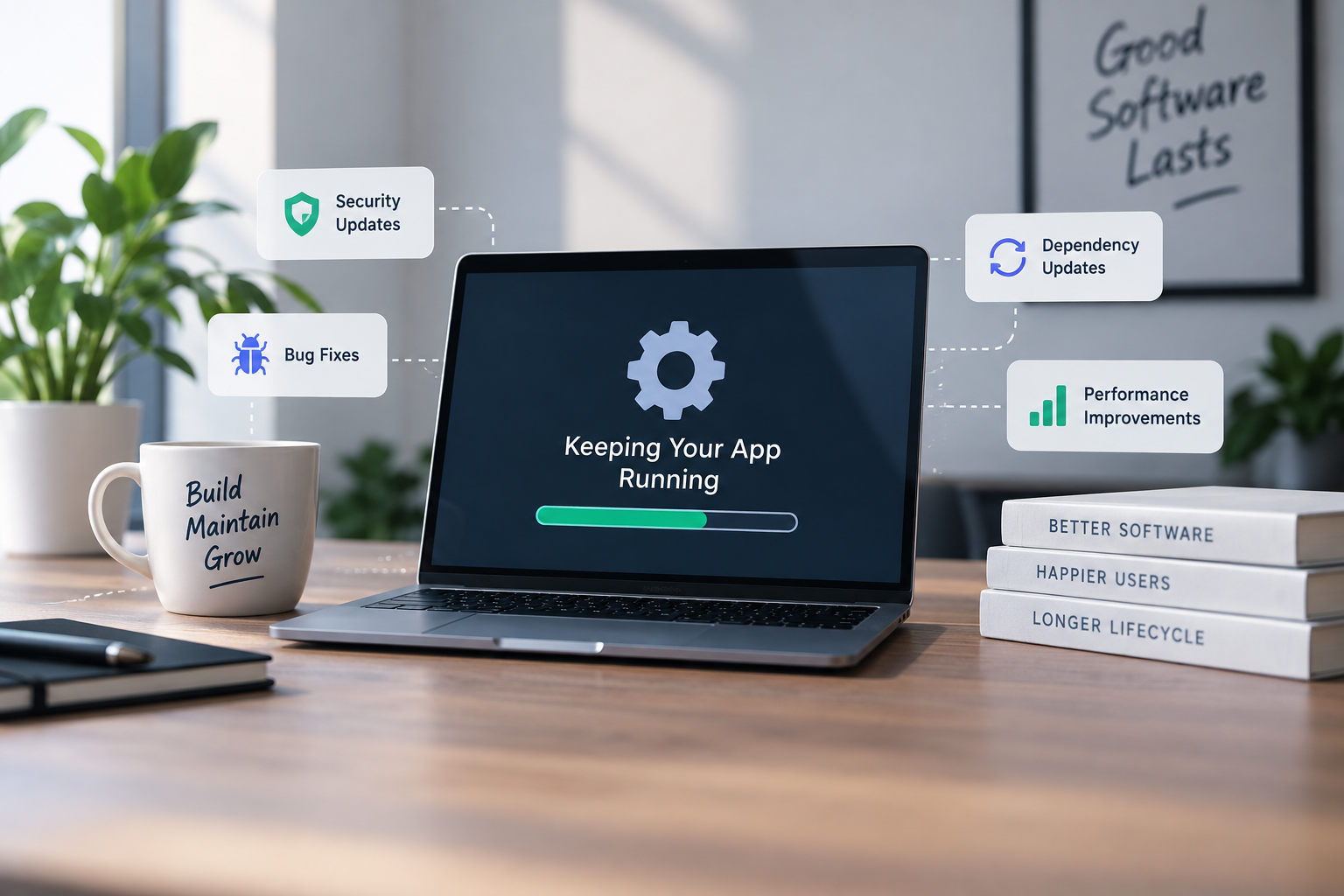
Keeping the app working as its environment changes around it — OS updates, new device sizes, third-party API changes, dependency updates. This work doesn’t add features; it prevents the app from breaking as everything around it evolves.
Perfective Maintenance
Improvements to performance, usability, and code quality that don’t add new functionality but make the existing product better and cheaper to maintain going forward.
Preventive Maintenance
Proactive work to catch problems before they become emergencies — security patching, monitoring, dependency audits. This is the category most commonly skipped when budgets get tight, and the one that causes the most expensive problems later.
In a mature, well-maintained application, adaptive and perfective work should make up the majority of the maintenance budget. If your maintenance bill is dominated by corrective fixes instead, that’s usually a signal about how the app was originally built, not about maintenance pricing.
The Real Cost of Skipping Maintenance
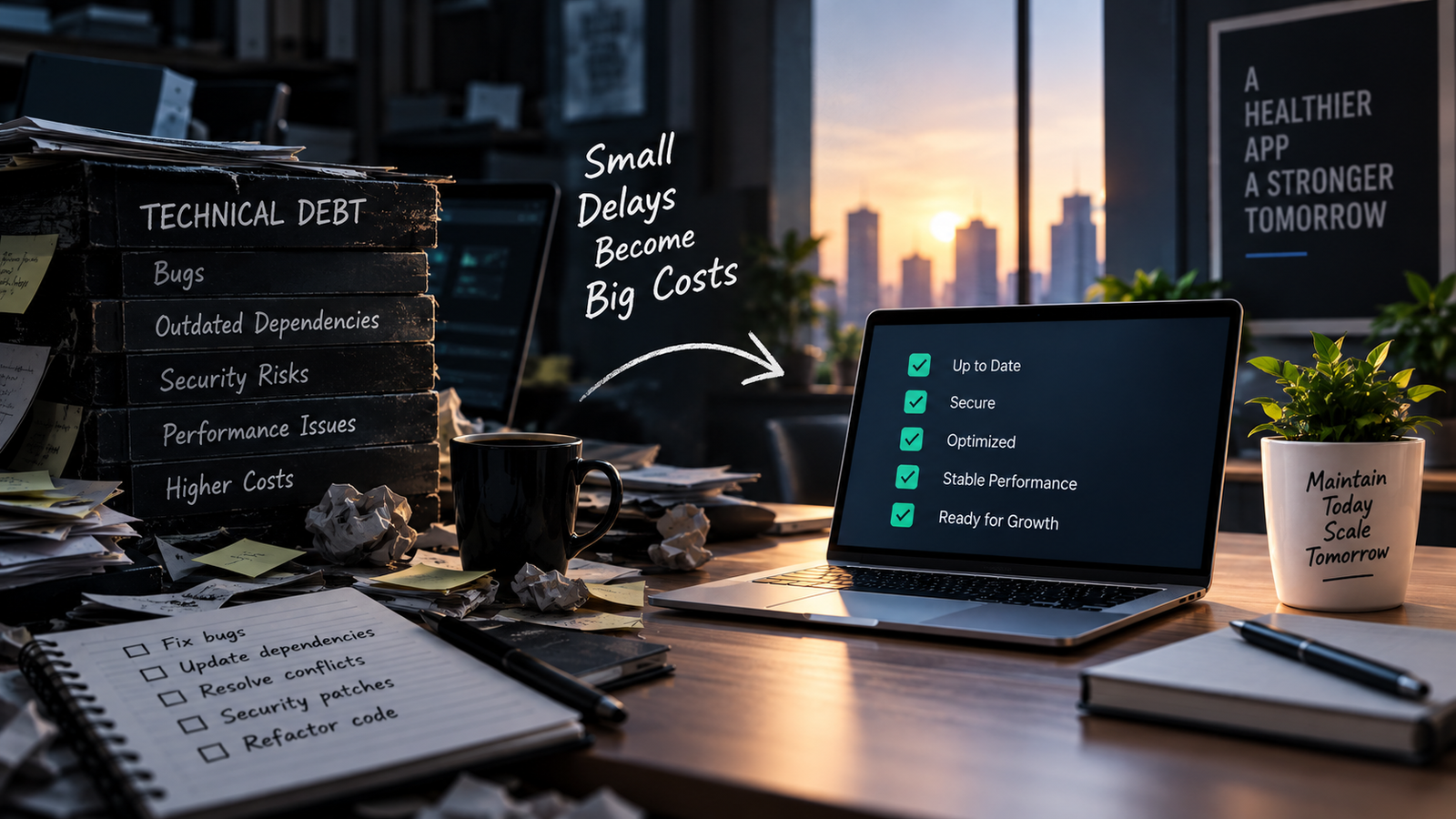
Deferred maintenance isn’t avoided cost — it’s postponed cost, and it compounds. Stripe’s Developer Coefficient research found that developers lose an average of 17.3 hours per week — 42% of a working week — to technical debt and code quality issues. That’s not a one-time cost. It’s a permanent tax on every future feature and fix, and it only grows the longer maintenance is deferred.
A useful way to think about it: a year of skipped dependency updates might take a few days to resolve. Two years of skipped updates can take weeks, because major version jumps introduce breaking changes that cascade through the codebase. The bill doesn’t disappear when you skip it — it accrues interest.
What Drives Your Specific Number Higher or Lower
Codebase Age and Technical Debt
Older, less documented code requires diagnostic time before any fix can even begin, which raises effective cost regardless of how complex the actual bug is.
Architecture
A bug fix in a modular system affects a predictable, isolated piece of code. The same fix in a tightly coupled system can require testing the entire application — one of the more overlooked cost multipliers in maintenance budgets.
Number of Integrations
Every third-party service you depend on is a potential source of breaking changes outside your control. More integrations generally means more adaptive maintenance work.
Regulatory and Compliance Requirements
Applications handling regulated data — healthcare, financial services, anything touching PCI, HIPAA, or similar frameworks — typically see maintenance costs run above the standard 15-20% range, since compliance changes trigger mandatory code and documentation updates on their own schedule, not yours.
Whether Maintenance Was Planned From the Start
An application built with maintainability in mind — clean architecture, real documentation, sensible dependency choices — costs meaningfully less to maintain than one built purely to hit a launch deadline. This is a build-time decision with years of downstream cost implications.
How to Evaluate a Maintenance Quote
A maintenance quote without a breakdown is hard to evaluate on its own. Before agreeing to one, it’s worth understanding:
- What’s included, specifically. Does the quote cover security patching and dependency updates, or only bug fixes? These are different scopes with very different long-term implications.
- Whether it’s fixed-scope or open-ended. A maintenance retainer with clearly defined hours or deliverables is easier to budget against than a vague “ongoing support” line item.
- Who owns the code and infrastructure. If your maintenance provider also owns your source code or hosting, switching providers later becomes expensive and disruptive — a form of lock-in worth avoiding from the start.
- Whether preventive work is included, or only reactive fixes. A maintenance plan that only responds to problems after they happen is missing the category of work that prevents the expensive emergencies in the first place.

How Paracon Approaches Post-Launch Support
Every Paracon engagement includes a defined post-launch support phase, not as an afterthought bolted onto the original build, but as part of the same team and architecture decisions made from day one. Because our Discovery Phase documents your application’s full technical specification before development starts, the team maintaining your app after launch has the same context as the team that built it — no ramp-up period, no guessing at undocumented decisions.
You also own your source code and infrastructure outright, which means your maintenance arrangement is never a lock-in. If your needs change, you’re free to bring the work in-house or move to another provider without starting from zero.
Frequently Asked Questions
How much should I budget for app maintenance annually?
A reasonable planning baseline is 15-20% of your original development cost per year, based on the industry benchmark established by Gartner and Forrester research. A $100,000 app should budget roughly $15,000-$20,000 annually for standard maintenance, with regulated or highly complex applications running higher.
Does maintenance cost go up or down over time?
It typically increases as a share of cumulative project cost over time, since the original build cost is fixed while maintenance continues indefinitely. This is expected and not itself a warning sign — what matters is whether the maintenance work stays proportionate to your original benchmark or grows faster than your business.
What’s the difference between maintenance and new feature development?
Maintenance keeps your existing application running and secure — bug fixes, dependency updates, security patches, monitoring. Feature development adds new capabilities your users don’t have yet. These are different budget categories and should be planned separately, since conflating them makes both harder to budget accurately.
Can I reduce my maintenance costs?
Yes, primarily through decisions made during the original build. Clean, modular architecture, real documentation, and choosing well-supported dependencies all reduce ongoing maintenance cost meaningfully. Investing in maintainability during development is consistently cheaper than paying for its absence later.
Is it cheaper to handle maintenance in-house or through a development partner?
It depends on your team’s existing capacity and expertise. In-house maintenance makes sense if you have engineers with the specific context and availability to take it on. A development partner makes more sense when that capacity doesn’t exist internally, particularly if the same partner has direct knowledge of how the application was built.
Budget for the Whole Lifecycle, Not Just the Launch
The build cost is the number everyone budgets for. The maintenance cost is the number that determines whether the project stays healthy for years afterward. Both deserve real planning from the start.
If you’re scoping a new application, Paracon’s Discovery Phase produces a fixed-price development quote and a clear picture of what ongoing support looks like, so you’re planning for the full lifecycle, not just the launch. Book a free consultation to talk through both numbers.